
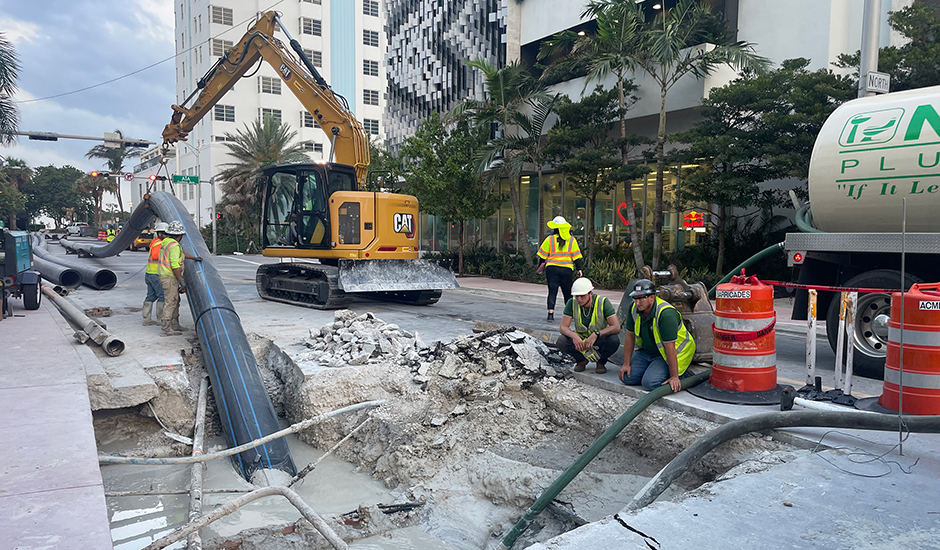
City crews began tearing out lead water pipes along Alton Road on Wednesday, July 29, swapping outdated lead service lines for modern materials on a 20-block stretch between 43rd and 63rd Streets in the mid-Beach corridor.
The City of Miami Beach announced the project Tuesday, July 28, calling it an important infrastructure upgrade that will enhance long-term water quality and bring the system into compliance with current federal standards. The July 29 start date was reported by HelloCity, a community aggregator; the city itself did not specify when work would begin.
The project is one piece of the $450 million infrastructure program commissioners approved 5-2 on Wednesday, July 22, funded by water and sewer rate increases that will push a typical homeowner's monthly bill from $106 to $150 by 2031. We reported on that vote when it happened.
What's a lead service line?
A lead service line is the underground pipe connecting a building to the city's water main in the street. It runs from the main, through the right-of-way, to the water meter and into the property. Lead can leach into drinking water as these pipes corrode over time, and the EPA says lead service lines are typically the most significant source of lead contamination in tap water. In Florida, lead-based plumbing materials are more likely to be found in homes built before 1991.
The city says the old lead lines are being replaced with "safer, modern materials," though it has not specified whether the new pipes are copper, high-density polyethylene, or another option.
How many properties are affected?
Both Miami Beach and Miami-Dade Water and Sewer Department say the likelihood of finding lead service lines in their systems is low, but neither agency has released a specific count or percentage of affected properties. The city's inventory is still being finalized; some properties remain listed as having service lines of unknown material, and the city is actively contacting those customers to complete a survey identifying their pipe type. Residents can check their own status on the city's public Water Service Line Inventory Map.
Nationally, the EPA estimates roughly 4 million lead service lines still serve properties across the United States. Florida's projected count is approximately 64,000, based on initial inventory data from surveyed water systems.
Why it matters
Lead in drinking water poses serious health risks, especially for pregnant women and young children. The EPA has established there is no safe level of lead exposure for children, whose growing bodies absorb more lead than adults. In children, lead exposure can cause lower IQ scores, decreased academic achievement, and increased behavioral problems.
Miami Beach's own 2025 Water Quality Report shows the city's distribution system tested at 7.02 parts per billion for lead at the 90th percentile. Two of 60 homes sampled exceeded the EPA's action level of 15 ppb. The city's drinking water comes from the Miami-Dade Water & Sewer Department, which draws from the Biscayne Aquifer, but lead contamination typically enters through service lines and home plumbing rather than the water supply itself.
The federal Lead and Copper Rule Improvements, finalized in October 2024, require all water systems to replace every lead service line by Nov. 1, 2037. Florida utilities must submit a baseline inventory and replacement plan to the state Department of Environmental Protection by Nov. 1, 2027.
What residents should know
The city has not released a completion date for the Alton Road work, nor has it disclosed how many individual service lines will be replaced along the corridor. Following a replacement, Miami Beach conducts water quality tap sampling between three and six months later to ensure lead levels are below 10 ppb, and provides affected residents with a point-of-use pitcher filter certified for lead removal.
Residents concerned about lead can flush their tap for 30 seconds to two minutes before drinking or cooking when water has been sitting for several hours. More information on lead testing and a list of accredited local laboratories is available at miamibeachfl.gov/mbsips.






.jpg)