
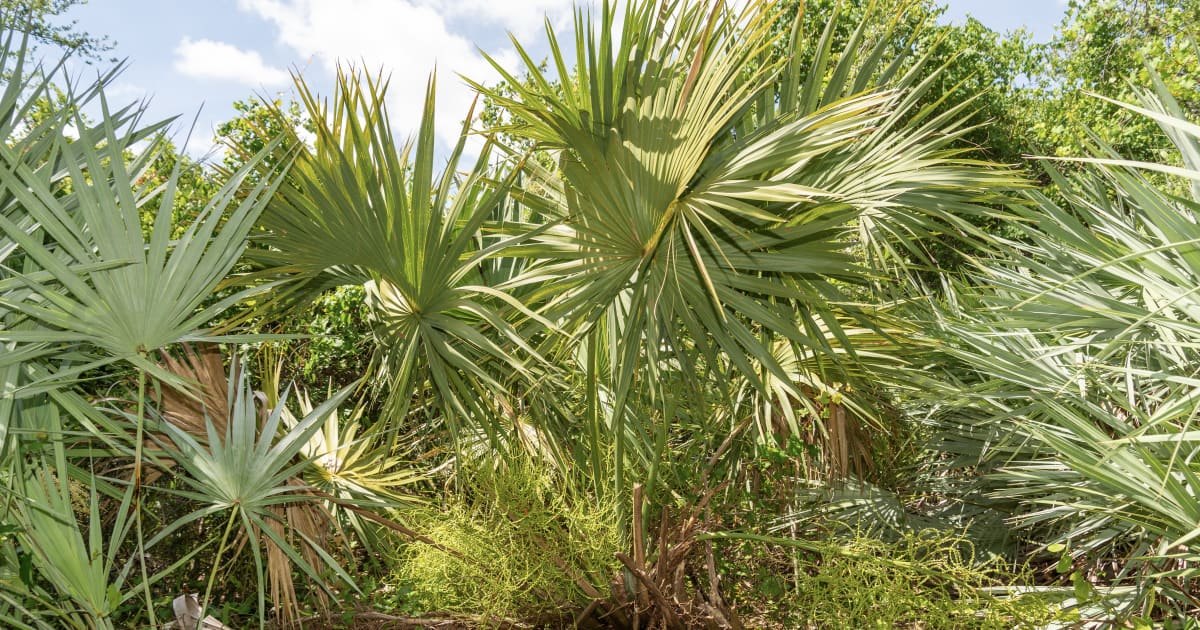
A palm species native to Miami-Dade County, believed extinct in the wild for more than four decades, has been rediscovered. A Florida International University doctoral student is now sequencing its genome to guide a comeback.
Daniel Tucker, a doctoral candidate in FIU's Earth Systems Science program, co-discovered and formally documented living wild populations of the Miami palmetto, or Sabal miamiensis, in 2024. His peer-reviewed paper, published in PALMS, the journal of the International Palm Society, marked the first confirmed wild sighting of the species in decades.
The palm once grew across Miami-Dade's pine rocklands and along the Atlantic Coastal Ridge as far north as Boca Raton. Rapid urbanization wiped out 98% of that pine rockland habitat outside Everglades National Park, and the species was formally listed as extinct in the wild in 1998.
Tucker tracked the palms alongside Larry Noblick, palm biologist emeritus at Montgomery Botanical Center in Coral Gables, and Tim Joyner, preserve manager with Miami-Dade County's Department of Regulatory and Economic Resources. The team located about 40 individual plants in a small, publicly protected preserve surrounded by development. A year later, they found another 60 nearby.
"It was an incredible moment because it's a lot of emotions all at once," Tucker said in an FIU profile published Monday. "You know that now there's hope. You have something in front of you that you know you can work with."
Roughly 100 wild Miami palmettos are all that remain.
Tucker, who also holds a Montgomery Botanical Graduate Fellowship at the 122-acre Coral Gables research garden, is now sequencing the species' full genome. The reference genome will let scientists identify optimal breeding pairs and cryopreserve genetic material, creating an insurance policy against future habitat loss.
The Garden Club of America and the Center for Plant Conservation awarded Tucker the 2026 Catherine H. Beattie Fellowship in Conservation Horticulture, a grant of up to $4,500, to fund the genomics work. The fellowship was announced June 23.
The conservation effort extends beyond the lab. Montgomery Botanical Center has cared for rescued palms and mature specimens collected in the 1980s and 1990s, and seeds and young plants have been distributed to other botanical gardens as a safeguard.
Patrick Griffith, director of Montgomery Botanical Center, said in a July 2024 interview that the species was already very rare when first described 40 years ago and that a few palms were rescued from the path of development at that time.
The team has identified reintroduction sites in partnership with Miami-Dade County's Environmentally Endangered Lands Program and plans to plant about 50 individuals in the wild by early 2027.


.jpg)